Prion proteins occupy a singular place in biology as agents of conformational catastrophe, yet the view of amyloidogenic sequences as uniformly pathological has been softening for years. Several amyloid-associated proteins, including amyloid-β and the cellular prion protein, have been reported to display antimicrobial or host-protective activity, raising the possibility that aggregation-prone proteins may harbor cryptic antimicrobial fragments within their primary sequences. Whether such encrypted peptides are broadly distributed across prion and prion-like proteins had never been systematically tested. Against a backdrop of rising antibiotic resistance, the question carries practical weight: prion-associated proteomes span an enormous, taxonomically diverse sequence space that conventional antibiotic discovery programs have never mined.
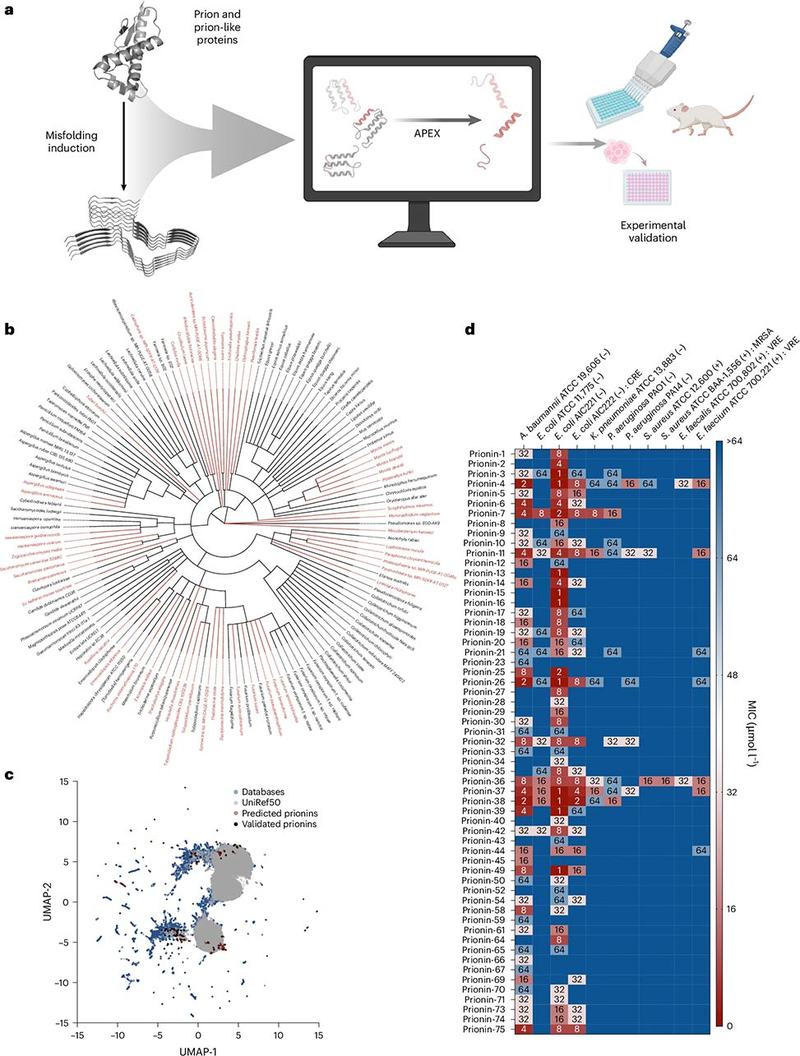
Researchers in the de la Fuente-Nunez Group at the University of Pennsylvania, published in Nature Microbiology, addressed this gap by applying APEX 1.1, a deep learning framework for antimicrobial peptide, AMP, discovery, to a curated set of 2,897 UniProt entries annotated as prion or prion-related. The team enumerated all unique 8–50-residue fragments from those entries, generating 19,324,138 candidate peptides. APEX 1.1 predicted species-specific minimum inhibitory concentrations, MICs, against an 11-pathogen panel that included carbapenem-resistant, methicillin-resistant, and vancomycin-resistant strains. Fragments with a predicted median MIC of ≤64 μmol l−1 across that panel were designated prionins. To ensure chemical diversity, the team selected 75 top-ranked candidates enforcing less than 70% sequence similarity to known AMPs and to each other before committing to synthesis via Fmoc solid-phase peptide synthesis.
Experimental testing confirmed that 59 of the 75 synthesized prionins inhibited at least one pathogen at ≤64 μmol l−1, and 42 achieved MICs of ≤16 μmol l−1 against at least one strain. Activity concentrated against Gram-negative organisms, with multidrug-resistant isolates included among the susceptible strains. Sequence-space projection showed that prionins overlap only partially with AMPs from curated databases, occupying a related but physicochemically distinct region consistent with both convergent evolution and genuinely unexplored sequence territory. Prionins were on average longer, more cationic, and more hydrophobic than database AMPs, without uniformly maximizing classical amphipathic patterning. Circular dichroism revealed that many prionins adopt largely disordered conformations in water yet shift toward more ordered secondary structures in membrane-mimetic environments, consistent with inducible folding on target engagement. NPN uptake and DiSC3-5 depolarization assays confirmed that 53 prionins permeabilize both the outer membrane and the cytoplasmic membrane of Escherichia coli AIC221, often to levels comparable to the reference antibiotic polymyxin B.
Selectivity profiling against human red blood cells and HEK293T cells showed that haemolysis was rare, with only one of 75 prionins exhibiting haemolytic activity within the tested range, though cytotoxicity was more frequent. Sixteen prionins combined antibacterial activity with neither measurable haemolysis nor cytotoxicity at the highest concentrations tested. Two leads advanced into a murine skin-abscess model of Acinetobacter baumannii infection: prionin-7, derived from the fungus Thelonectria olida, and prionin-38, derived from Caenorhabditis elegans. A single topical dose at 10× MIC, administered one hour after infection, significantly reduced bacterial burden at day 2 relative to untreated controls, with efficacy comparable to polymyxin B. At day 4, prionin-38 maintained an approximately three-log reduction in burden; prionin-7 showed a more modest approximately one-log reduction. No treatment-associated weight loss was observed in either group.
These results establish prion and prion-like proteins as a productive source space for antibiotic discovery and extend the concept of encrypted AMPs to a protein class not canonically associated with host defence. The authors note that the study does not demonstrate natural release of prionins during infection or confirm physiological roles as innate immune effectors; those questions remain open for future investigation. Nevertheless, the work provides a framework for probing whether amyloidogenic sequence features and membrane-active antimicrobial function can coexist within the same protein, and it broadens the repertoire of unconventional proteomes available to deep-learning-guided antibiotic discovery programs targeting drug-resistant pathogens.